


The Beginner's Battle: From Stuck to Started

“Treating myself like a precious object will make me strong.” — Julia Cameron
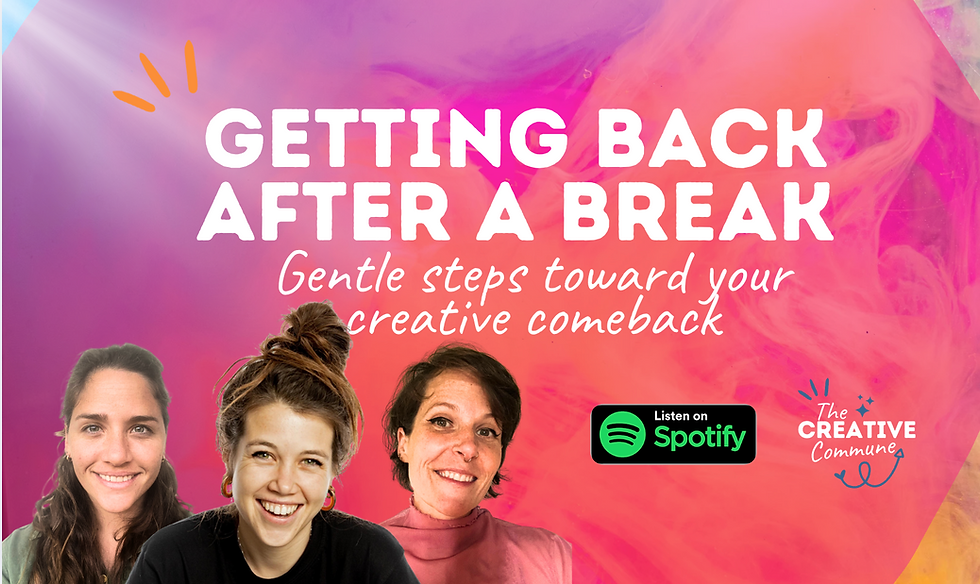
Beginning again can feel thrilling and terrifying all at once. After years in a craft, the “beginner” label can sting: clumsy hands, wobbly confidence, the awkward gap between what you imagine and what you can do. In this episode of The Creative Commune, Amy, Daniela, and Demi unpack why beginner energy is essential—and how to make re-entry gentler, braver, and way more effective.
Why beginner energy matters (even if you’re seasoned)
Cross-training for your creativity. Taking up something unrelated—tap, hot yoga, embroidery—opens fresh neural paths that feed your core practice in surprising ways.
Curiosity over mastery. As Barbara Sher argues in Refuse to Choose!, multi-passionate “Scanners” don’t need to pick one lane. Sampling new skills satisfies curiosity and ultimately enriches your primary work.
Keep some things sacred (and unmonetized). Not every new love needs to become a product. Let certain beginner pursuits stay blissfully money-free.
Break vs. block: know which one you’re in
Artist’s break = a needed downshift after a push, a holiday, or a life change. It ends when you feel a quiet pull to return.
Artist’s block = the break morphs into avoidance because anxiety/perfectionism takes the wheel.
Quick check: Are you postponing because you’re truly resting—or because you’re afraid to feel clumsy again?
Set your “victory conditions”
Before you start, define what success looks like now:
“Try one class and see.”
“Sketch for 10 minutes, three times this week.”
“Share one messy WIP with a friend.”
Small, explicit wins lower the stakes and build momentum.
Safety fuels spontaneity
Play requires a sense of safety—internally and in the room. Try:
Body first: a walk, gentle stretching, a song you can’t help but move to.
Familiar soundtrack: comfort TV as white noise can settle nerves and invite tinkering.
Kind company: sketch-and-coffee dates, low-stakes workshops, people who clap for attempts, not just outcomes.
Chaos vs. balance (and why you might need both)
New beginnings are messy. Supplies migrate across the house. Ideas scatter. Let a little creative chaos happen while you explore—then corral it with light systems:
One tray for the current project
A “proof-of-work” folder for daily scraps
A weekly 30-minute tidy to reset the space
Keep your reliable “cash cow” tasks minimal but humming so you can throw yourself into the experiment without derailing life.
A gentle re-entry plan (7 days)
Day 1: Clear a surface. Set a 15-minute timer. Make marks; stop when it rings.
Day 2: Write your victory condition. Pick one tiny tool or constraint (3 colours / single brush).
Day 3: Beginner move: non-dominant hand for 10 minutes.
Day 4: Artist Date—gallery, paper shop, nature walk. No outcomes.
Day 5: Repeat Day 1 with the same constraint. Take one photo of progress.
Day 6: Coffee + sketch with a friend. Share one honest sentence about how it felt.
Day 7: Choose one micro-habit to repeat next week (10-minute studies, five days).
Tools that actually help
Scanner Daybook (à la Barbara Sher): park every new idea so it inspires you without derailing you.
Future-Work list: a living log of low-lift ideas tagged “10 min,” “needs daylight,” “needs shop trip,” “collab.”
The 10-Try Rule: you’re only allowed to quit after attempt #10. Discomfort ≠ a bad fit; sometimes it’s just newness.
Reframes for your inner sensor
“I’m not lazy; I’m on a break.”
“Clumsy means I’m learning.”
“Today’s goal is to show up, not to impress.”
“Done beats flawless—especially at the beginning.”
The real joy of being a beginner
Yes, it’s vulnerable. But the payoff is huge: freedom, fresh energy, and a wider, wilder creative life. Treat yourself like the precious object Julia Cameron describes—soft hands, strong spine—and you’ll find your way back, not in a sprint, but in steady, human steps.
Want support?
If you need help spotting the line between break and block—or want a kind accountability plan for your comeback—check our coaching and mentoring options at The Good Place. We’d love to cheer your first, wobbly, wonderful steps.


Comments